
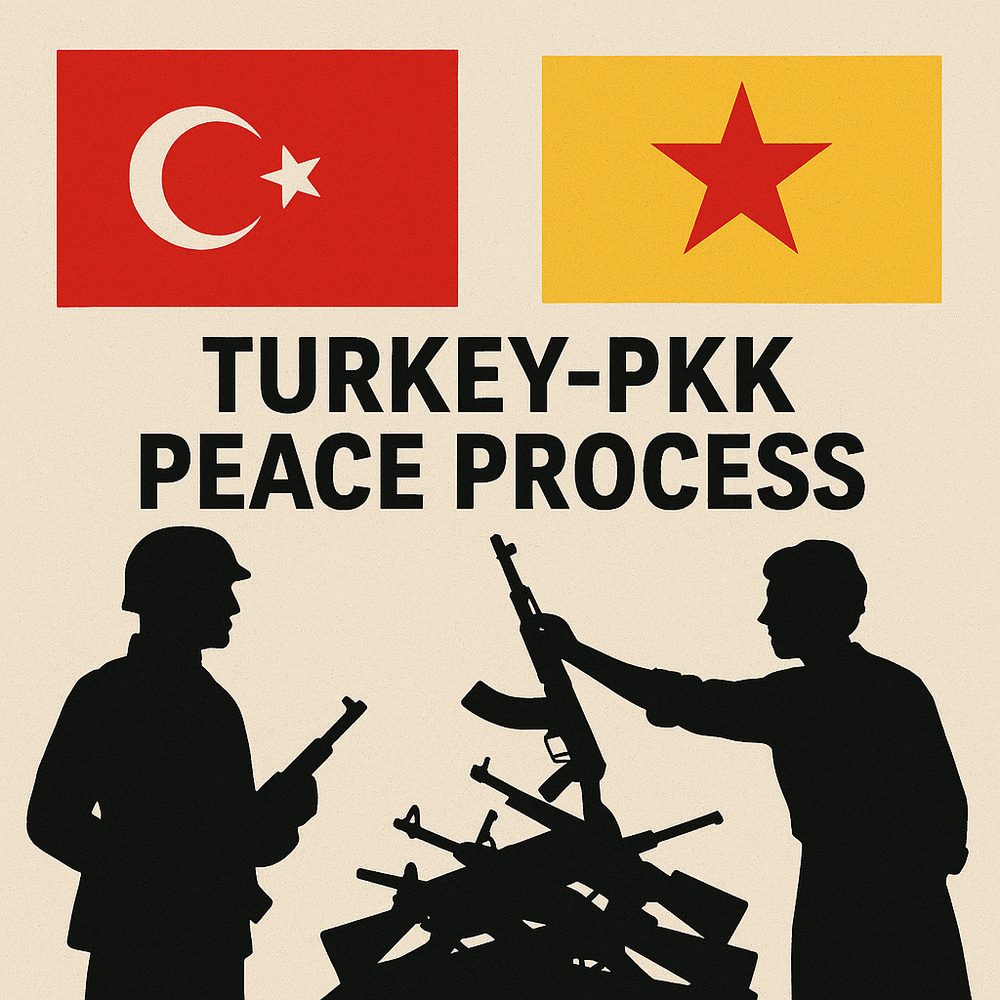
Who in Turkey is afraid of peace with the Kurds?
Story summary
According to KurdPress, the peace process with the Kurds in Turkey is not limited to negotiations between the government and Kurdish actors, but has also confronted Turkish society with a fundamental question about the future of the country: who supports the end of the armed conflict and the beginning of a political process, and who sees peace as a threat to their political and social position?
On the one hand, there are groups that see the end of the conflict and the possibility of Kurdish political participation as an opportunity to end the human and economic costs of decades of conflict.On the other hand, there are trends that associate reconciliation with “giving concessions,” weakening the government’s position, or changing the political and social balance in the country.
An analysis published by the journal Amarji uses the experience of Colombia to explain this gap. The main argument is that the distance of individuals and groups from the battlefield can affect their perception of peace. Those who have paid the most for the war are usually more sensitive to the possibility of a return to conflict and may therefore have a more cautious and realistic approach to reconciliation.
In contrast, those who have been distant from the battlefield for decades may see the costs of reconciliation more in the form of political retreat or concessions.In this view, the compromises necessary to end a war can be interpreted simply as “defeat” or “giving concessions to the other side.”
As Amarji puts it, “He whose house has not burned down speaks easily of fire.” This refers to the gap between those who have directly paid the price of war and those who decide about war and peace from a safer distance.
In this perspective, one of the most important groups supporting peace can be found among the communities most affected by the conflict. Families of victims, Kurdish areas, and sectors of society that have experienced the economic and social consequences of the war have a powerful incentive to prevent a return to violence. For these groups, peace is more about the lives, security, and futures of families than it is about an abstract political issue.But the opponents of the peace process cannot be explained simply as “nationalist.” Part of the opposition may stem from concerns about the political and social consequences of integrating the Kurds into the country’s political structure. Questions such as what position the Kurds will have in politics after the conflict ends, to what extent they will enter state and political institutions, and what changes their presence will make to existing relations are among the concerns addressed in the article.
In this context, peace for some groups does not only mean the end of the war; it can also mean changing relations that have been formed over decades. Therefore, part of the opposition may stem from concerns about the loss of existing positions and privileges.
The Colombian experience that Amarji cites is important for understanding this issue.In the 2016 referendum on the peace agreement between the Colombian government and the FARC, the agreement was rejected by a very small margin. But the main significance of the result was the geographical difference in the “yes” and “no” votes. The peripheral and poorer regions, which had suffered the most from the war, overwhelmingly supported peace, while the central and wealthier regions, which were further from the battlefield, overwhelmingly voted against the agreement.
This experience shows that in order to analyze support for or opposition to peace, one should not simply look at slogans and political positions; one must also ask who will pay the price if the peace process fails. In the case of Turkey, this question is also particularly important, because a return to armed conflict primarily affects the regions that have already borne the greatest human and security costs in the past.
However, the end of armed conflict alone does not guarantee lasting peace.The Colombian experience shows that implementation is just as important. Economic and social programs can increase support for peace when local people see their tangible effects in their daily lives. In the study cited by Amarji, projects related to livelihoods, agriculture, and economic infrastructure had a positive impact on public satisfaction, while some projects even caused dissatisfaction, due to high expectations or suspicions about how they would be implemented.
Therefore, the Turkish peace process cannot simply become a political agreement between elites. For peace to be consolidated, the participation of local communities, transparency in the implementation of the agreement, political guarantees, and a sense of social ownership of the peace process are essential.From this perspective, the alignment between peace advocates and opponents can be analyzed beyond a simple division of “Kurds versus Turks” or “nationalists versus peacemakers.” In fact, it is also about differences in war experience, social status, political interests, and concerns about the consequences of change.
Peace advocates focus primarily on ending violence, reducing human costs, and enabling political participation. Opponents or critics of the peace process, on the other hand, tend to emphasize its potential risks to security, political structure, national identity, and social balance. The central question between these two perspectives is whether a mechanism can be created that addresses the concerns of the different parties without returning the country to a cycle of violence.
The Colombian experience also has another lesson: peace is sustainable when people feel they have gained something tangible from it.Therefore, the end of war must be accompanied by changes in the economic and social life of the affected areas; otherwise, the political agreement may not enjoy the necessary social support.
Finally, Amarji’s article does not see peace as simply declaring an end to war, but rather as a form of social and geographical justice. According to this view, the voices of those who have paid the most for the conflict should have a more prominent place in determining the future of the peace process. The question is not just who speaks most loudly for peace or war; the more important question is who will have to pay the price again if peace fails.
User comments