
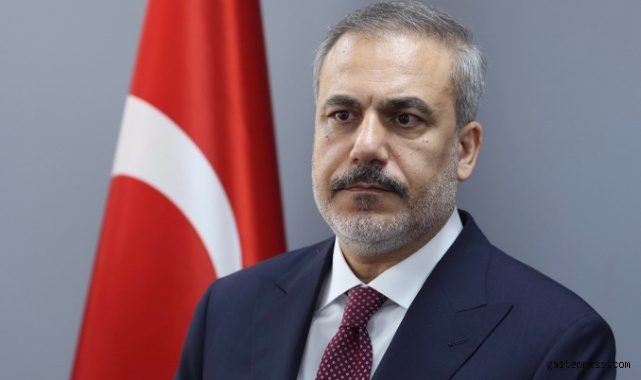
Turkish FM accuses US, Europe of ‘allying with PKK’ in Syria
Story summary
Fidan was speaking at budget talks in parliament on Monday.
Turkey considers the the Kurdish People’s Protection Units (YPG) to be an extension of the PKK, which is listed as a terrorist organization by Turkey and much of the international community.
The YPG comprises an integral part of the US-backed Syrian Democratic Forces (SDF) — the Kurds’ de facto army in the area — that spearheaded the battle to dislodge Islamic State group jihadists from the region in 2019, Turkish Minute reported.
“Unfortunately, some countries continue to support the PKK-YPG terrorist organization under the pretext of fighting against [the Islamic State]. We keep emphasizing that this is a strategic mistake and that they should absolutely rely on legitimate partners in the fight against [the Islamic State].”
“We have once again strongly emphasized that America’s cooperation with the PKK-YPG, the presence of FETO [the Gulen movement] in the US and unilateral sanctions are incompatible with the spirit of the alliance,” Fidan said.
FETO is a derogatory term used by the Turkish government to refer to the faith-based movement inspired by US-based cleric Fethullah Gülen as a terrorist organization.
The Turkish government accuses the Gülen movement of masterminding a failed coup on July 15, 2016 and labels it a “terrorist organization,” although the movement strongly denies involvement in the coup attempt or any terrorist activity.
Speaking about Turkey’s messages to the Council of Europe member states, Fidan said, “The message we have conveyed is that Turkey is one of the countries with the highest percentage of implementation of ECtHR judgments among the member states. We have an 89 percent implementation rate.”
“We said these cases are politicized in European capitals even before they come to court and that they have gone from being a legal case to being a part of domestic politics in Turkey. So when you politicize these cases, when you override the law, that’s the answer you get from here. Why do you find that strange?”
Turkey, which has refused to implement the rights court’s rulings in the cases of jailed Kurdish politician Selahattin Demirtas and prominent businessman and civil society leader Osman Kavala, was also unsettled by a decision from the court’s Grand Chamber last month about a teacher who was convicted of terrorism due to his links to the faith-based Gulen movement.
The court faulted Turkey for the conviction of the teacher, Yuksel Yalcinkaya, on Gulen links due to his alleged use of a mobile application, his bank account and labor union membership. The court concluded that Yalcinkaya’s conviction violated several legal principles enshrined in the European Convention on Human Rights: the right to a fair trial, the principle of no crime without law and the right to association.
President Recep Tayyip Erdogan and Justice Minister Yilmaz Tunc also spoke out against the ECtHR’s Yalcinkaya decision and accused the court of exceeding its authority.
Turkey, which many say underwent an erosion in the rule of law following a coup attempt in 2016, was ranked 117th among 142 countries in the rule of law index published by the World Justice Project (WJP) in October 2023.
User comments